

Although in situ RNA detection techniques have been around for decades, they have largely been ineffective when it comes to distinguishing between highly homologous targets. Lacking the specificity needed to reliably distinguish pathogens whose rRNA are more than 98% similar. Due to this drawback PCR has become the gold standard molecular method for disease profiling at the cost of clinically relevant information regarding the cellular and tissue context, which is lost with PCR's grind-and-bind approach.
ChampDx's proprietary InfectISH™ technology is a novel RNA in-situ hybridization (ISH) assay capable of detecting ribosomal RNA (rRNA) within intact cells and tissue. The combination of its proprietary probe design and amplification scheme ensures that only target-specific signals are amplified and not background noise from non-specific hybridization.
How It Works
Utilizing a proprietary probe design algorithm combined with a curated database of rRNA sequences InfectISH™ is able to discriminate between highly homologous bacteria, fungal and protozoan pathogens.
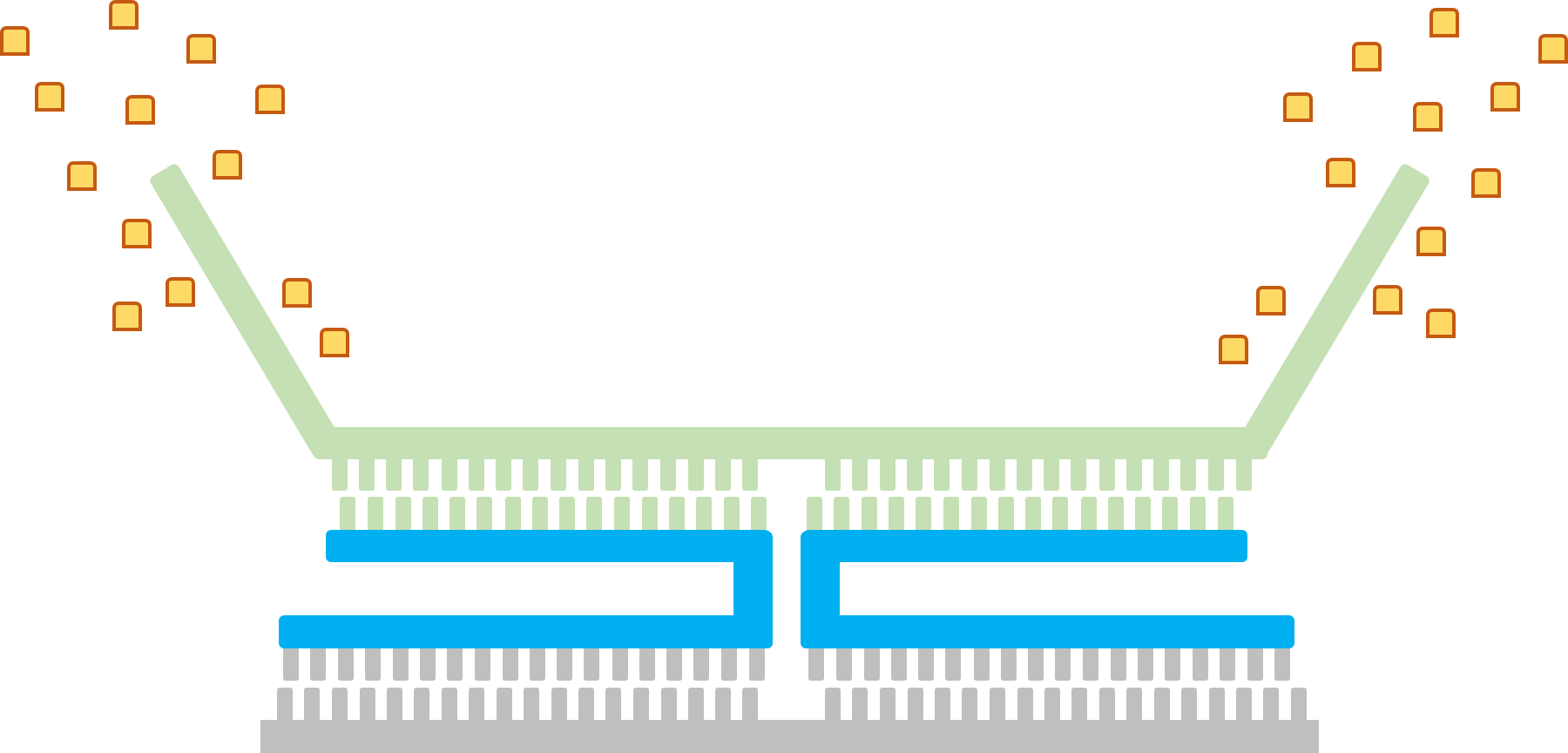
Unlike current RNA ISH assays, InfectISH™ is specifically designed around the challenges inherent to targeting highly amplified and homologous targets consisting of two independent probes (mirror C) target probes and a proprietary amplification scheme.

Step 1.
Pairs of mirror C target probes hybridize to specific regions of targeted pathogen's rRNA.

Step 2.
An amplifier binds to the 36-base binding site formed by each mirror C probe pair.
Step 3.
Label probes bind to the numerous binding sites on the amplifier.
Each Mirror C Probe Consists of Three Parts
The lower region of the C consists of an 18- to 25-base region that is complementary to the target RNA and is selected based on specific hybridization properties.
A spacer sequence that connects the lower base sequence to the upper region which is a 14- to 18-base tail sequence.
When both mirror C probes hybridize bind next to each other the two tails form a 28- to 36-base binding site for signal amplification.